
In Lagos State, Nigeria’s sprawling megacity, sexually abused children from poor homes endure a second betrayal, a justice system riddled with extortion, indifference, and impunity. As anguished families wrestle with endless delays and crushing costs, perpetrators roam free. In this investigation, Christiana Alabi-Akande unveils how poverty silences the vulnerable, transforming justice from a basic right into a luxury only a few can afford.
On Wednesday, 30 September 2020, Favour Okechukwu, 11, was gang-raped to death in Ejigbo, a low-income suburb in Lagos State.
Family games
The victim’s family had expected swift justice, but almost five years later, it remains a mirage.
Frustrated by her failure to secure justice for her late daughter, the deceased’s mother, Ruth Okechukwu, a petty trader, surrendered to her grief, clinging to God for justice.
“The police made us believe they were working on the case and promised to get to the root of the matter, but nothing was done,” she told DevReporting.
From the transportation of Favour’s remains for autopsy to the endless visits to different police stations, the deceased’s relatives were responsible for every dime. Even as they grieved, they realised that seeking justice comes with a financial burden.
With teary eyes, Mrs Okechukwu narrated that: “My husband took her body from Isolo General Hospital to Ikeja for the autopsy on 18 November 2020 because we were told that the doctor could not go to Isolo. The mortuary attendant helped us arrange for an ambulance. We paid for the ambulance and funded the entire process. The autopsy process lasted from morning until night.
“We were assured the result would be ready within two to three weeks. But we never saw the result. The doctor claimed to have submitted it to the police, yet the police said they never received it. We were also kept in the dark about the outcome of the forensic test conducted at the scene of the rape. The suspects who were reportedly arrested were later released”.
When contacted by DevReporting, the lawyer in charge of the case, Alex Ishogba, explained that the Magistrate Court, sitting in Oyingbo, Ebute Metta, initially remanded the suspects in Kirikiri correctional centre (prison) and sought legal advice from the Directorate of Public Prosecution (DPP).
The lawyer, engaged by the poor family, said when the DPP reviewed the case file sent by the Lagos State Police Criminal Investigation and Intelligence Department (SCIID), Yaba, they found major gaps – key documents like the sperm test results, autopsy report, and fingerprint evidence linking the suspects to the victim were missing. With no evidence in the file, the DPP advised releasing the suspects. “The magistrate court then released them based on this advice.”
“Before the legal advice was released, I went to the DPP and I was told that the police messed up the case, because they didn’t put the medical reports and all the evidences in the file,” the lawyer added.
In order to get justice for the family of the victim, Mr Ishogba said he took the case to the Federal High Court in Ikoyi to sue for the enforcement of fundamental human rights. However, the court ruled there was not enough to link the suspects to the case.
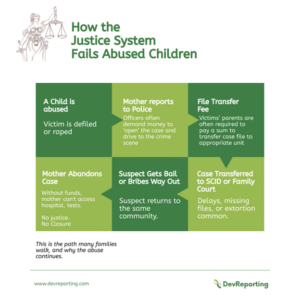
For many poor parents of sexually abused children in Nigeria, God becomes their last resort when the criminal justice system, meant to protect them, ends up extorting and shielding the children’s abusers, forcing countless children to carry invisible scars, wounds etched by sexual abuse at the hands of those meant to protect them.
In the absence of justice
A 2020 study titled “Justice Through the Lens of Survivors,” conducted by the Domestic and Sexual Violence Response Team (DSVRT) revealed that when justice is well administered to survivors, it could give a sense of relief and closure.
But findings by DevReporting revealed that the path to justice is littered with costs that many poor families cannot afford. They range from police ‘mobilisation fees’ to payment for medical reports, chartered vehicles and case entry fees, among others.
Family games
As a result, many who cannot afford to bear the financial burden or who get frustrated by endless court adjournments and delayed judgments, give up and abandon their cases.
Such failures threaten progress towards achieving Sustainable Development Goal 16.2, which seeks to end all forms of violence against children.
However, findings by this newspaper reveal that the Lagos State Government supports the Police Gender Unit in the state financially to investigate these kinds of cases and get justice, without burdening relatives of abused children with incessant demands for money.
The Police Gender Unit is the central police unit in Lagos State Police Command, where most sexual violence cases are transferred to from divisions for further investigations before being charged in court.
Ugly trend
Child Sexual Abuse (CSA) is a silent health emergency that goes unnoticed, grossly under-reported and poorly managed, as very young children rarely have the vocabulary to describe what happened. Perpetrators exploit this vulnerability, committing their crimes under a culture of silence and stigma.
A 2024 UNICEF data revealed that 370 million (one in eight) girls and women alive today globally experienced rape or sexual assault in childhood, while 240 to 310 million (one in eleven) boys and men experienced rape or sexual assault during childhood. While children suffer different forms of violence, sexual violence is said to leave scars that last a lifetime.
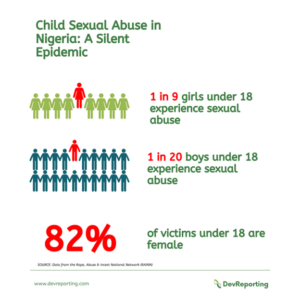
The prevalence of child sexual abuse in Nigeria is alarming, as one in nine girls and one in 20 boys under the age of 18 experience sexual abuse or assault, while 82 per cent of all victims under 18 are female, according to a data from Rape, Abuse, and Incest National Network (RAINN), an international nonprofit anti-sexual assault organisation.
During the COVID-19 lockdown in 2020, the Nigerian Police recorded about 717 cases of rape and defilement of minors across Nigeria. Late Favour was one of them.
About 799 suspects were arrested, 631 cases conclusively investigated and charged in court, while 52 other cases were left under investigation, as the then Inspector-General of Police, Mohammed Adamu, blamed the surge in the number of cases at the time on COVID-19 restrictions.
The federal government declared a state of emergency on sexual and gender based violence in all 36 Nigerian states, an action triggered by brutal rape cases across the country.
Victims’ parents lament
Like Favour, the story of Evelyn*, another victim of sexual abuse, echoes the same pain and systemic neglect faced by many sexually abused children in Lagos State.
According to Evelyn’s mother, Esther Agbim, a tea seller at Cele Market, along Mile 2-Osodi road in Lagos, her daughter, who was 10 years old in September 2023, told her that their neighbour, Lucky Bassey, invited her into his room and rubbed his manhood on her private part.
Shocked by this revelation, Ms Agbim reported the case at the Ijesha Police Station, leading to Mr Bassey’s arrest.
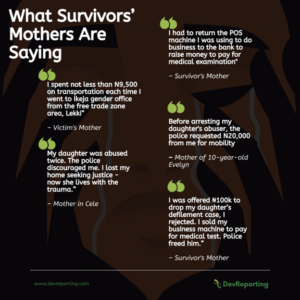
Before the suspect’s arrest, the police requested ₦20,000 from Ms Agbim for ‘mobility,’ but after pleas, she paid ₦5,000.
After a medical examination at Mirabel Centre, a sexual assault referral centre, confirmed that the girl had been defiled and sustained wounds in her vagina, some neighbours and police officers allegedly pleaded with the mother to drop the case. After much pressure and a lack of financial strength, Ms Agbim reluctantly succumbed.
Ms Agbim recalled: “The Investigating Police Officer (IPO) of the case, Madam Grace, pulled me aside and tried to dissuade me from going to the Ikeja Gender Unit. She claimed that the procedures at Ijesha Police station were no different from those at the unit, adding that many had already interceded on the perpetrator’s behalf.”
According to her, the policewoman later proposed that Mr Bassey sign an undertaking to stay away from the abused child, adding that his older brother had agreed to move him out of their compound. “I had to agree with them,” Ms Agbim told DevReporting, amid regret.
Months later, Mr Bassey accosted Evelyn for the second time in their shared bathroom and had carnal knowledge of her. The child kept silent for days after the second assault due to fear. When she finally told her mother, she said Mr Bassey covered her mouth so no one would hear her scream.
Determined not to let him escape a second time, Ms Agbim returned to the police to file another report, but then, Mr Bassey had fled, and every attempt to apprehend him proved unsuccessful.
According to Ms Agbim, each time Mr Bassey briefly returned home and she alerted the police, they would not take any action.
“Instead, I was constantly directed from one police station to another,” she said, adding that; “To worsen the situation, my landlady threatened to evict me from my apartment if I didn’t drop the case against Mr Bassey. But I have chosen not to drop it.”
She insisted that if the police had acted appropriately the first time, the second sexual assault might never have happened.
“Now, I have been ejected from my apartment, and my daughter lives with the trauma. After the incident, she would often complain of stomach pain, and at one point, vomited worms. I can only imagine the pain she endured. I know I am going through all of this because I don’t have the means to pursue justice. If only I had the money to hire the best lawyer, maybe I would get justice,” she told DevReporting.
Disillusioned with the justice system, Ms Agbim sought help from the Advocates for Children and Vulnerable Persons Network (ACVPN), a non-governmental organisation.
Addressing the possible connection between sexual assault, stomach pain, and vomiting worms, Public Health Physician, Mohammed Ibrahim, a professor, explained that when heavily infected, children in Nigeria can sometimes vomit worms, especially the common roundworm Ascaris. He emphasised that this is a recognised medical occurrence and is not related to sexual assault.

He further noted that abdominal pain can arise from many different causes, noting that, medically, its significance depends on the nature and location of the pain as well as other associated symptoms and signs.
Mr Ibrahim, however, mentioned that abdominal pain may result from sexual assault or from a variety of other causes. “The doctor can only determine the actual cause after fully examining the patient,” he added.
DevReporting contacted Mr Bassey for comments, but he did not respond to calls and many text messages sent to his known phone number on the allegations against him.
A story too many
At Lakowe community in the Ibeju Lekki area of Lagos, a mother of two, Amuanamua Overere, recounted a distressing incident involving her five-year-old daughter, Sophia*.
According to Mrs Amuanamua, Sophia was defiled by a neighbour identified as Frederick on 29 October 2023 when she was three years old. She had gone to refill her cooking gas cylinder and left her daughter at home. On her way back, she saw Mr Frederick, who was heading out to buy fish.
“He offered me one of his gas cylinders so I could boil water to bathe my baby. Later that day, unknown to me, he gave Sophia money to buy biscuits and instructed her to return the change to him. After handing him the change in his room, he made her watch a movie before penetrating her with his fingers. She returned with torn underwear and knickers, crying when I eventually found her after searching for over four hours.”
Mrs Amuanamua told DevReporting that she found her daughter crying with red and swollen eyes. “Sophia told me he bathed her afterwards,” she said.
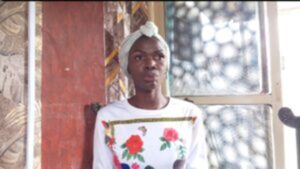
Mrs Amuanamua Overere
When she reported the incident to the community leader (Ba’ale), community members pleaded with her not to escalate it, offering to refund all expenses she had incurred on her daughter’s health, but Mrs Amuanamua refused.
Upon realising that the community wouldn’t act, she reported to the Akodo Police Station on 1 November 2023, and Mr Frederick was arrested five days later. She was thereafter referred to Akodo General Hospital for a medical examination, which cost ₦10,000. This was in addition to purchasing gloves for the hospital.
She said: “I had to return the Point of Sale (POS) machine I was using to do business to the bank, so I could raise money to pay for the medical examination.
“When I returned to the hospital for the result, I was told the doctor had gone on leave. I waited for a whole month to get the result. During the waiting period, the Police released Mr Frederick”.
Mrs Amuanamua said the community later turned against her, while her landlord asked her to vacate her apartment.
“Later, a woman reached out, saying she was sent by Frederick to offer me ₦100,000 to drop the case. I asked her if she would let Frederick go free if he had abused her daughter.
Also, the Investigating Police Officer (IPO), identified as Ryan, said they granted Mr Frederick bail because I had not produced the doctor’s report in time. He shouted at me, saying I made allegations without evidence.”
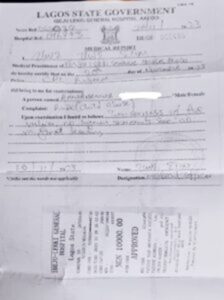
Mrs Amuanamua said after she submitted the medical report to the Police, nothing was done, and Mr Frederick had disappeared from the community. She was later introduced to Harmony Advocacy Network, an NGO, and on 28 November 2023, the case was transferred from Akodo Police Station to Ikeja Gender Unit, where she got a new IPO, identified simply as Mr Kunle.
“The woman in charge of the Ikeja Gender Unit said the police needed to visit the crime scene and asked me to hire a vehicle to take them to Oshoroko. I told them I didn’t have the money and went home. Already at that time, each time I visited the gender officer from the Lekki free trade zone area where I reside, I spent nothing less than N9,500 on transportation up until December.”
Later in December 2023, Sophia’s mother told DevReporting that the Police called to inform her that they were coming to the Oshoroko community to investigate her case.
“They met with the Baale’s deputy, who assembled local women. Shockingly, my neighbour, Mummy Halimo, whose daughter was earlier playing with Sophia, denied seeing her that day. Even a boy who had earlier confirmed seeing Sophia enter Frederick’s room also denied it after he was threatened. I burst into tears as everything unravelled. Weeks later, Mr Frederick reportedly relocated, as my daughter continues to live with trauma.
“All I want is justice for my daughter,” she said amidst sobs, even as little Sophia told this newspaper that, “He touched my yansh.”
DevReporting made several calls and text messages to Mr Fredrick’s contact, but his phone was unavailable.
Many laws, yet no justice
According to sections 358 and 359 of the Criminal Code Act – Part Five, anyone who commits the offence of rape is liable to life imprisonment. Again, an attempt to commit the offence is felonious and the offender is liable to a 14-year-imprisonment upon conviction.
Also, Lagos is one of the states in Nigeria that has domesticated the Child’s Rights Act and underage persons are unfit to give consent for sexual acts. So even if it were to be proven that an underage victim gave consent, it would be regarded as rape. In such a circumstance, it is referred to as statutory rape.
Section 31 of the Act states that a person who commits an offence of ‘defilement’ (i.e sexual intercourse with a child) is liable on conviction to life imprisonment.
But five years of data trends from the DSVA indicate that children consistently account for between 30 and 42 per cent of total reported cases annually.
Meanwhile, Section 5 of the DSVA Law 2021 states that part of the agency’s functions is to coordinate immediate responses to sexual and gender-based violence. It is also meant to provide financial assistance, subject to the availability of funds, to high-risk survivors of sexual and gender-based violence for logistics to various responder agencies, case management, medical assistance, sexual assault counselling, psychosocial support, business seed grants, cost of relocation, or any other form of allowance or assistance necessary.
In his reactions, Ebenezer Omejalile, co-founder and chief operating officer of Advocates for Children and Vulnerable Persons Network (ACVPN), said the path to justice for many sexually abused children from low-income families is littered with insurmountable costs. According to him, it has become a norm that the oppressed cannot get justice if they do not know anybody to push their case.
Family games

Mr Ebenezer Omejalile
“It is very shocking that despite the training and capacity building programmes, the police in the family support or gender unit have acquired, some of them still exhibit a high level of incompetence in the way they go about cases. A child has been defiled, yet they are subjecting her to outrageous costs. Perpetrators are always ready to pay any amount to escape being punished by the law,” he told DevReporting.
Mr Omejalile said: “Based on our encounter, some police officers want to turn themselves to law courts, prosecutors or judges. We’ve seen situations where complainants who are not accompanied to the police stations are frustrated by officers right from the ‘counter’, denying them access to the unit meant to handle their case.
“We have a case that is still ongoing in the Ikorodu Magistrate’s Court. There is a prosecutor there who is in the habit of telling the magistrate that defilement and rape cases are family matters. They are also in the habit of not letting the victims know the date for the next sitting. For most cases, they provide weekend dates. Tell me, which court sits on weekends?”.
INVESTIGATION [II]: In Lagos, police extort families of sexually abused children in search of justice

The first part of this investigation narrates harrowing accounts of sexually abused children and the deep scars they now live with. But beyond these personal stories lies a bigger picture, one painted in stark numbers. In this second part, DevReporting’s Christiana Alabi-Akande went undercover to some police stations in Lagos to expose how security operatives extort families of victims, even at their vulnerable moments.
What data shows
Investigations by DevReporting have revealed grim statistics of sexually abused children in Lagos, a city nicknamed Nigeria’s commercial capital and one of the largest and fastest-growing economies in Africa.
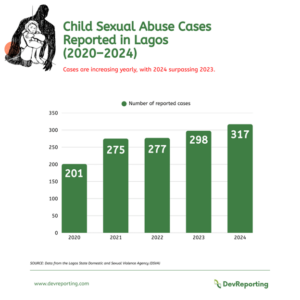
In 2020 alone, the state recorded 4,302 cases of domestic and sexual violence, according to the Domestic and Sexual Violence Response Team (DSVRT), a government agency responsible for coordinating responses to sexual molestations and child abuse in the state.
The data indicated that children accounted for 1,718 of those cases, including 109 cases of defilement, four cases of minor-to-minor defilement, and 88 cases of sexual harassment.
In 2021, DSVA said 3,943 cases were reported, out of which 1,222 involved children, including 172 cases of defilement, 58 cases of sexual assault by penetration, and 45 attempted rape or attempted sexual assault by penetration.
The agency recorded 5,929 cases in 2022, with 2,486 cases involving children, comprising 230 defilement cases, 33 sexual molestation cases, and 14 cases of defilement/sexual molestation involving minor-to-minor.
In 2023, the number of reported cases increased to 6,389, with 2,576 involving children, comprising 263 defilement cases and 35 cases of sexual molestation.
The agency’s 2024 annual report shows 6,456 reported cases in the year, with 2,531 involving children, which comprises 223 defilement cases, 93 sexual assault (molestation) cases, and a single case of defilement by a minor-to-minor.
Police Gender Unit
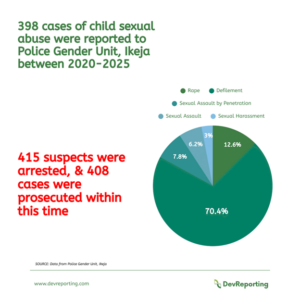
Meanwhile, the Lagos State Police Command said 398 cases of child sexual abuse were reported to its gender unit between 2020 and 2024. These, it said, included 50 cases of rape, 280 cases of defilement, 31 cases of sexual assault by penetration, 25 cases of sexual assault, and 12 cases of sexual harassment.
In its response to DevReporting’s inquiry, the police, in a letter signed by the second officer in charge of the gender unit, Ndumfiok Emmanuel, a superintendent of police, said that though the unit might not be able to provide the specific number of convictions, 415 suspects were arrested and 408 cases were prosecuted during the period under review.
Lagos’ fight against sexual abuse
Through DSVA, Lagos is one of the few Nigerian states with a structured framework for addressing domestic and sexual violence and safeguarding child rights.
Findings by DevReporting revealed that the state provides financial support to the police gender unit, which coordinates all gender-based desks across police divisions in the state.
It was gathered that 21 family support units (FSUs) operate across different police divisions, handling cases of domestic violence, sexual assault, child abuse, and other family-related issues. In divisions without FSUs, such cases are managed by the Juvenile, Women and Children (JWC) unit or the Human Rights unit.
The police stations with FSU are located in Adeniji Adele, Ajah, Ajegunle, Alakuko, Badagry, FESTAC Town, Ikotun, Igando, Ikeja, Ilupeju, Ipaja, Ikorodu-Igbogbo, Ikorodu-Imota, Ikorodu-Owutu, Okokomaiko, Bariga, Epe, Isokoko, Surulere, Ilasan-Lekki, and Ketu.
DSVA said it offers financial assistance to police gender units. Its Executive Secretary, Titilola Vivour-Adeniyi, a lawyer, told DevReporting that because the police play a critical role in ensuring that perpetrators are held accountable and sometimes serve as the first point of call for survivors, the agency provides monthly financial support to aid police investigations and ensure that cases are swiftly charged to court.
She said: “We have a good working relationship with the police. Aside from building their capacity to ensure they are exposed to best practices for investigating cases, we provide them with financial support monthly to support investigations and ensure that cases are charged to court swiftly.”
Mrs Vivour-Adeniyi did not state the specific amount being given to the police monthly.
Similarly, the officer in charge of the police gender unit, Ikeja, Toyin Kazeem, an Assistant Commissioner of Police (ACP), who confirmed that the unit receives support from DSVA, also failed to disclose the specific amount.
The unit also noted that within the last five years it has received support from the office of the Lagos State First Lady, Claudiana Sanwo-Olu; the Cece Yara Foundation, Ministry of Youth and Social Development (MYSD), and the Lagos State Security Trust Fund.
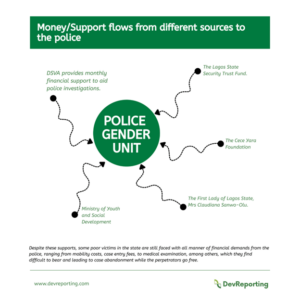
According to the unit, survivors/victims are referred to medical facilities where medical services are free for all survivors of SGBV cases in the state, such as police medical facilities, Mirabel Centre, Women at Risk International Foundation (WARIF) and Idera Sexual Assault Referral Centre, among others.
Mrs Kazeem, the unit boss, however said the support offered the unit may not necessarily mean money, citing the MYSD, which she said has been supportive in the area of allowing the unit access to its external shelter, especially for child survivors.
She also mentioned that the unit got a van donation from the Police Trust Fund to aid logistics.
Where is accountability?
A schedule of budget estimates and actual expenditures from 2020 to 2024 obtained from the Office of the Accountant-General of Lagos State shows a rise in funding for the DSVA, particularly in overhead and capital allocations.
In 2020, N8 million allocated to the unit was fully spent on overheads, with no capital expenditure recorded, as DSVA had not yet become a full-fledged agency. The same amount was recorded for 2021.
But from 2022, following its establishment as an independent agency, the budget allocations surged. That year, N627.4 million was estimated for overhead costs, with an actual expenditure of N480.8 million. Capital expenditure was estimated at N100 million, with N73.3 million spent.
In 2023, the overhead estimate stood at N559.3 million with N504.3 million spent, while capital expenditure stood at N6.34 million with N6.32 million spent.
The 2024 estimate for overhead was N473.5 million, with an actual of N472.8 million, and capital was N47,385,851 with an actual of N29,623,540.
Despite these significant allocations, DevReporting’s request for breakdown of specific line items and expenditure by the agency was not provided by the agency. This made it impossible to verify how much of these funds were directed towards supporting survivors of sexual violence or what is channelled as financial support to the police gender units.
Despite streams of support, extortion persists at police stations
At about 11:30 a.m. on 10 July, this reporter, accompanied by a mother and child, visited Gowon Estate Police Station, located along Ipaja Road in Alimosho Local Government Area of Lagos State, posing as people willing to profile the case of a four-year-old girl who a young man in the neighbourhood defiled.

At the station, they were directed to the Juvenile, Women, and Children (JWC) unit, where a policewoman, identified simply as Officer Oyin, requested the details of the incident. She said a formal statement should be made.
The child’s mother pretended to be distraught. She was harshly scolded by the officer, who accused her of carelessness and blamed her for the supposed sexual violation of the child.
The female officer also briefly interrogated the child and a statement was taken. However, she said since the Divisional Police Officer (DPO) and the officer in charge of the juvenile unit were unavailable to properly handle the case, she listed some of the requirements to pursue the case to include payment of N5,000 for case entry, and payment for transportation of officers to the scene of the crime.
The complainants pleaded with the officer to reduce the cost, explaining that they were not aware any payment was required. Officer Oyin eventually collected N1,000 and gave them a medical form to be taken to Aregbesola Medical Health Centre, Egbeda, a public health centre located within the Alimosho local government area.
Officer Oyin further said, “After visiting the scene of the crime, we will refer this matter to the Gender Unit at the state command in Ikeja and then, you will have to bring money for chartering a vehicle to move everyone connected to the case, including police from the division to the Gender Unit in Ikeja.
“Then, all documentation already done at Gowon Estate Police Station will be replicated at Ikeja. You should also be ready to mobilise for another visit to the scene of the crime, this time, for the team from the Gender Unit.”

Meanwhile, at the health centre, an unidentified official who attended to this reporter said the test is free but that the family of the victim would purchase gloves for the use of the healthcare workers to conduct the test.
Like Gowon, like Elere
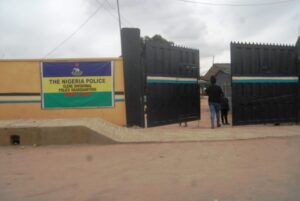
Similarly, on 21 July, this reporter visited Elere Police Station, Agege Local Government Area of the state, where she pretended to be a good Samaritan seeking justice for a 10-year-old sexually abused maid.
Also, the officer in charge of the station’s juvenile unit was not on seat, and efforts to reach her on the phone were to no avail as she did not pick the calls to her phone. The policewoman at the station, who said she could not give the exact amount it would cost to mobilise the police to pursue the case since her boss was not around, demanded N50,000 to cover “case entry” for the brief statement made by the reporter, and “other logistics necessary for the arrest of the alleged perpetrator.”
“We will go with a male police officer in case the perpetrator proves stubborn. We’ll also have to give the officer something. But if you don’t have up to ₦50,000, you can tell us what you can afford,” said the policewoman, simply identified as Bose.
Isokoko police station stands out
Also in Agege, the situation was different at Isokoko police station. The reporter had reported that a three-year-old daughter of her friend’s younger sister was defiled by a young man in their compound.

The policewoman, identified simply as Rebecca, was furious and committed to taking action. She, however, requested a referral from either DSVA or an NGO as a precondition to taking action.
“If we see the referral letter, we will first need to see the mother of the child and the child for interrogation. What it will cost you is not much; the difficult area is going to court. You will open a file, and after the investigation, we will duplicate the file and send it to the Directorate of Public Prosecution (DPP) for legal advice, then you will go to court. It’s only that area that can cost you some money, in the form of financial support,” the policewoman, Ms Rebecca, said.
Isheri-Oshun police station
Also, on 21 July, the reporter visited Isheri-Osun Police Station in Alimosho Local Government Area, where a policewoman, identified simply as Pepe, requested to see the victim.
“You will come with the complainant so that I will follow him to go and make an arrest, and if you want us to transfer the case to our headquarters, we will, but you will charter a vehicle that will take us there, you will pay to open a file, and you will see me big time,” she said.
Stakeholders speak
Commenting on the development, the Chief Executive Officer of Harmony Advocacy Network, Harmony Tachie, said many sexually abused children and their parents are silenced not just by trauma but also by poverty, as they are faced with the inability to afford medical examinations or legal representation.
She added that the fear of stigma or retaliation from perpetrators who are often known to the victims, combined with a general lack of awareness about their rights, further complicates the pursuit of justice.
“For these parents, the trauma doesn’t end with the violation. It deepens with every naira spent trying to report the case. From the first visit to a police station to the countless trips between hospitals, lawyers’ offices, and courts, the financial toll of seeking justice can rival the emotional one. In some instances, the police ask for money just to ‘open a file’, a practice that leaves the poor behind,” Mrs Tachie said.

The founder of DOHS Cares Foundation, a non-profit organisation that works towards freeing women, children, and vulnerable people from violence, abuse, and exploitation, Ololade Ajayi, said justice is often unattainable for indigent survivors because cases are quashed at the police station before reaching court.
Ms Ajayi said: “Police will ask for money if you want to pursue a rape case, except for the few officers who are conscious of the gravity of the offence. Imagine asking an indigent family to pay N20,000 or N50,000 just to fuel a car for an arrest. In a recent case in Ikorodu-Owutu, a policeman asked a groundnut seller to bring N20,000 before addressing her complaint.
“When I accompanied a lecturer to report her case, the IPO asked her to pay N50,000 before even listening, having known that she is a lecturer. The policewoman classified her based on her job and demanded money, supposedly to call and pick up the perpetrator.”
Such practices, according to Ms Ajayi, undermine justice and compel many survivors to settle privately, often under threat or inducement. “Violence against women and girls should not be treated as a private matter. It is a public issue requiring strong support systems. Too often, family or community pressure silences survivors,” she stressed.
Roadblocks to justice
Mrs Vivour-Adeniyi of DSVA confirmed that some individuals have had distressing encounters with certain law enforcement officers, due to blame game, victimisation, or demands for money before the case could be investigated.

While she hinted that several factors hinder the swift delivery of justice, she noted that the agency is working to build the capacity of the police.
According to her, major factors hindering the swift delivery of justice for sexually abused children include a lack of information as to what to do immediately after a child has been sexually abused. She said parents or guardians should not bathe a child who has been sexually abused, so as not to destroy evidence.
Mrs Vivour-Adeniyi said: “There is also a lack of information as to where to go. Some people go to a pharmacy to complain and get drugs, while some go to hospitals that are not designated to attend to sexual assault issues. Closely linked to that is the need to ensure that the case is reported to the police swiftly.”
She also spoke about the length of time it takes to prosecute cases, noting that the huge number of cases and lack of many special courts for such offences also make access to justice a difficult process.
“Our mandate is to coordinate response, provide services, ensure referrals are made promptly so that the survivor, post-trauma, can access all the critical support they need,” DSVA boss added.
Expert speaks on trauma of child sexual abuse
A psychiatrist and psychotherapist at the University of Ilorin Teaching Hospital, Abiola Tajudeen, a professor, described the impact of sexual abuse on children as deeply traumatic, noting that it leaves both physical and psychological scars that can last a lifetime.

He explained that beyond the physical violation, which may involve injuries such as vaginal tears or, in rare cases, Vesico-Vaginal Fistula (VVF), the mental and emotional scars are often far more enduring.
He added, “Sexual abuse is never by consent. It is a forceful violation of a child’s body and person. Even in cases where the child seems unaware of what happened at the time, the memory often resurfaces as they grow older, and it begins to shape how they see themselves and the world.”
Mr Tajudeen further noted that many victims carry deep emotional burdens such as guilt, shame, and confusion, which he noted may lead to mental health challenges such as depression, anxiety, and in severe cases, suicidal thoughts or psychotic episodes. He added that some victims may turn to drugs or alcohol to numb the pain.
“Over time, such unresolved trauma can affect a person’s identity and personality, as some develop personality disorders. Others engage in self-destructive behaviour or become anti-social, lashing out at others in anger or even joining criminal gangs to reclaim power,” Mr Tajudeen said.
NGOs offer lifeline
In the vacuum created by what experts describe as a failing justice system, non-governmental organisations have become the last hope for many survivors.
From providing legal aid and trauma counselling to covering transportation and hospital costs, these groups step in where the state steps back.
But then, the reach of the NGOs is limited, as they lament being overwhelmed by the growing number of cases and shrinking donor funds.
Mrs Ajayi of DOHS Cares Foundation said the government must prioritise funding for gender desks, provide shelter and holistic support for survivors, and allocate resources to civil society organisations working to end violence.
Sexual assault referral centres such as Mirabel, WARIF, CeCe Yara, and Idera also provide free medical, psychosocial, and referral services to survivors of rape and sexual assault.
According to the Centre Manager at Mirabel, Joy Shokoya, anyone who has experienced one form of sexual abuse or the other is qualified to visit the centre. “We receive survivors from police, schools, government agencies, and religious organisations. We also receive survivors from partner NGOs.”
She said that Survivors of rape or sexual assault do not need to go to the police first, saying medical and support services can be their initial point of contact. Ms Shokoya noted that this is crucial because treatments like emergency contraception and post-exposure prophylaxis are time-sensitive and must be administered within 72 hours.
As a way forward, Mrs Tachie recommended institutionalising free medical and legal support for survivors, training police and judicial officers to handle defilement cases with sensitivity, establishing a survivor fund for indigent families, and enforcing laws against police corruption and negligence more strictly.
Until then, she said, “the poor will continue to suffer twice, first from abuse, then from a justice system that doesn’t see them.”
This report was supported by the Wole Soyinka Centre for Investigative Journalism (WSCIJ) under its Report Women! Female Reporters Leadership Programme (FRLP).
Comments are closed.